Hidden Identity:
My passion is portraiture, mainly photographing children the reason for this is you as a photographer get to capture their essence. Children are natural, young, carefree and don't try to force expressions or emotions unlike adults, who force their smile for the portraits. They force something to how they think the perfect image is. This is one reason I prefer to photograph children. But... for this particular project I have changed my mind to go with using adults as my models. And also move away from my traditional approach to portrait photography.
What does my idea communicate? What has changed in regards to my idea?
My idea has changed slightly from my initial learning agreement, but still has the style and technique there which I had in the beginning. I will be still producing black & white, low key images using one main light. Choosing to do black & white, low key photographs I'm almost hiding the identity and taking away the smile. Using adults seemed more fitting than photographing children, trying to use kids would be like taking their innocence out of the image. By only using one light and lighting only parts of the image, wouldn't be as effective as using an adult. Most adults these days live their lives by hiding who they really are or trying to be someone/ something they are not. So by creating these dark low key images with the one light it will be like portraying their reality, living in the shadows of yourself. Concealing your true self from not only the world but most importantly you, yourself. Choosing to create my images in black & white I will be almost stripping the soul, like the darkness is their blanket to hide under and protect themselves.
Who are my influences?
My influences are still the same Giacomo Brunelli & Sally Mann. Brunelli is such a talented photographer and his images are so striking. His series of self portraits are really significant to what I'm producing myself. Hes used shadows to create his portraits so you don't see actually see him just the outline black shadow. Which could also give you the same narrative as what I'm explaining to the viewer in my images. You can see them they are there but not as who you or they think.
Sally Mann is another one who again expresses her families identity through her intimate photographs of her children and family. Portraying a lifestyle which is not for everyone but people still live that way. Same as my concept not everyone is like this but quite a large number will walk through their doors at night and hang up their mask they have been wearing all day. Sad really but so true.
How does this piece benefit my own practice?
My challenge is my lighting might not turn out as I want or vision in my own mind. So I'll have to play about with the light but I'll see how this turns out. Using only one light as a basic lighting set up will enhance my practice as a portrait photographer to create some more atmospheric scenes. The images I produce can go into my portfolio to give a little extra to clients. Its not something I usually do I'm more traditional in my portraits, so this will help with my portfolio also challenge me as its out my comfort zone.
Friday, 6 May 2016

SIZES & PRICES OF PRESENTING FINAL PORTRAITS
Printing Sizes:

The A2 size print measures 42.0 x 59.4cm, 16.53 x 23.39 inches, if mounted 59.4 x 76.6cm, 23.39 x 30.16 inches. http://www.stephenwiltshire.co.uk/paper_sizes.aspx
Prices for A2 prints -
Hayman creative:


The A2 size print measures 42.0 x 59.4cm, 16.53 x 23.39 inches, if mounted 59.4 x 76.6cm, 23.39 x 30.16 inches. http://www.stephenwiltshire.co.uk/paper_sizes.aspx
Prices for A2 prints -
Hayman creative:

John E Wrights:


Nottingham Trent Uni also offer printing at the size of A2 at a cost of £5.00 a print but I would have to mount them myself.
I chose to go with Hayman Graphics they are more expensive than the other printing places, but these offer quality and take the customer into consideration.
Tuesday, 3 May 2016
ARTIST RESEARCH
Artists that inspired my idea for the end of year show.
Giacomo Brunelli:


Giacomo Brunelli:
Commissioned by The Photographers Gallery, Giacomo Brunelli’s new body of work has been a two-year project to capture the heart of the capital where he makes his home. In Eternal London Brunelli uses his distinct film-noir style to create a unique and evocative view of the city. The images are framed around the silhouettes of people and animals. Though many London landmarks feature including Tower Bridge, Trafalgar Square, St. Paul’s Cathedral and the statue of Winston Churchill depicted alongside Big Ben, they are presented in a surprising and very particular way.
Brunelli photographs during daily early morning walks, randomly choosing a person to follow before focusing his camera on them. Working discreetly, he often uses a removable viewfinder, to be able to photograph his subjects from waist height and other unusual angles, such as directly from behind or using extreme close-up. He protects their anonymity by obscuring their faces whilst exploiting light, shadow and contrast to imbue his images with a dramatic atmosphere and a deep sense of mystery.
Giacomo Brunelli’s first major project, The Animals, has received great critical acclaim and was published as a book by Dewi Lewis Publishing. Brunelli has exhibited widely and has received several awards including the Sony World Photography Award, the Gran Prix Lodz, Poland, and the Magenta Foundation’s ‘Flash Forward 2009’. His work is held in many private and public collections including the Museum of Fine Arts Houston, The New Art Gallery Walsall, UK Kiyosato Museum of Photographic Arts and Portland Art Museum, USA.
http://www.cranekalmanbrighton.com/photographers-biogs/giacomo-brunelli-biography/ 29.04.16
http://www.giacomobrunelli.com/works.php 29.04.16
Brunelli's images have harsh contrast which I want in my own final images, He chooses black & white which gives the images an added air of mystery only seeing the shadows of the environment, animals or people. He focuses on parts of the image and does this by using light to his advantage.
Sally Man:
Sally Mann (born in Lexington, Virginia, 1951) is one of America’s most renowned photographers. She has received numerous awards, including NEA, NEH, and Guggenheim Foundation grants, and her work is held by major institutions internationally. Her many books include At Twelve (1988), Immediate Family (1992), Still Time (1994), What Remains (2003), Deep South (2005), Proud Flesh (2009), and The Flesh and the Spirit (2010). In 2001 Mann was named “America’s Best Photographer” by Time magazine. A 1994 documentary about her work, Blood Ties, was nominated for an Academy Award and the 2006 feature film What Remains was nominated for an Emmy Award in 2008. Her bestselling memoir, Hold Still (Little, Brown, 2015), received universal critical acclaim, and was named a finalist for the National Book Award. In 2016 Hold Still won the Andrew Carnegie Medal for Excellence in Nonfiction. Mann is represented by Gagosian Gallery, New York. She lives in Virginia.
“Few photographers of any time or place have matched Sally Mann’s steadiness of simple eyesight, her serene technical brilliance, and the clearly communicated eloquence she derives from her subjects, human and otherwise – subjects observed with an ardor that is all but indistinguishable from love.”
— Reynolds Price, TIME
— Reynolds Price, TIME
http://sallymann.com/about 29.04.16
http://sallymann.com/selected-works/family-pictures 29.04.16
I like Sally Mann's work for her style and tones she chooses for her images. Her images are quite different from Brunelli the tonal range is softer than Brunelli's but still selecting to use black and white you are captivated by the image . She photographed her children while at the time it was seen as controversial & explicit for the type of images she was producing, Sally Mann didn't see it that way, she was simply documenting her children and family growing up. As a child she ran around naked and had an open self confidence within her family and this is what she wanted for her own children. They lived in rural part away from city life so this enabled her to provide this way of life to her children, for them to be their selves not to hide away to embrace their youth and body with no care. She portrays her family's identity in these images something I will conveying in my final images hidden identity and the concept behind.
Lawrence Sumulong:
Lawrence Sumulong (b. 1987) is a Filipino American photographer based in New York City and Manila, the Philippines. In 2015, The Lucie Foundation selected him as an “emerging talent with vision and dynamic ideas that challenge and progress the art form of still photography into work that compels”.
Among others, his work has been featured by Burn Magazine, Chobi Mela VI, The GroundTruth Project, Huck Magazine, the Jorge B. Vargas Museum, Le Monde's M le magazine du Monde, the Milk Gallery, The New Yorker: Photo Booth, NPR, Photovisa VII: International Festival of Photography, and Verve: The New Breed of Documentary Photographers.
His postcard series for the publication, Abe's Penny, is in the permanent collection of New York's Museum of Modern Art Library and the Brooklyn Museum Library.
He has forthcoming work as a featured exhibitor at the 2016 Head On Photo Festival in Sydney, Australia. He is a 2016 grantee of The Pollination Project, which funds "individual change makers...emphasizing projects that expand compassion and generosity in the world".
He is the photo editor at Jazz at Lincoln Center and their Sony imprint label, Blue Engine Records.
Among others, his work has been featured by Burn Magazine, Chobi Mela VI, The GroundTruth Project, Huck Magazine, the Jorge B. Vargas Museum, Le Monde's M le magazine du Monde, the Milk Gallery, The New Yorker: Photo Booth, NPR, Photovisa VII: International Festival of Photography, and Verve: The New Breed of Documentary Photographers.
His postcard series for the publication, Abe's Penny, is in the permanent collection of New York's Museum of Modern Art Library and the Brooklyn Museum Library.
He has forthcoming work as a featured exhibitor at the 2016 Head On Photo Festival in Sydney, Australia. He is a 2016 grantee of The Pollination Project, which funds "individual change makers...emphasizing projects that expand compassion and generosity in the world".
He is the photo editor at Jazz at Lincoln Center and their Sony imprint label, Blue Engine Records.
http://worldphoto.org/profile/337531/ 29.04.2016
I like how Lawrence Sumulong has created these portraits, as if applying a mask or filter to the image. There not the traditional portraits he has made them different and unique like us as human beings are, again these could go back to being about identity obscuring ones true identity. I like this approach to portraits though something I might try out in my own practice something different to offer potential clients.
Anton Corbijn


Anton Corbijn
Corbijn began his career as a music photographer when he saw the Dutch musician Herman Brood playing in a café in Groningen around 1975. He took a lot of photographs of the band Herman Brood & His Wild Romance and these led to a rise in fame for Brood and in exposure for Corbijn.[17]
From the late 1970s the London-based New Musical Express (NME), a weekly music paper, featured his work on a regular basis and would often have a photograph by him on the front page. One such occasion was a portrait of David Bowie wearing a loincloth backstage in New York when starring in The Elephant Man.. In the early years of London-based The Face, a glossy monthly post-punk life style / music magazine, Corbijn was a regular contributor. He made his name photographing in black-and-white but in May 1989 he began taking pictures in colour using filters. His first venture in this medium was for Siouxsie Sioux.[18] Between 1998-2000, in collaboration with the painter Marlene Dumas, he worked on a project called "Stripping Girls", which took the strip clubs and peep shows of Amsterdam as their subject;[19] while Corbijn later exhibited photographs, Dumas took Polaroids which she then used as sources for her paintings.
Corbijn has photographed Bob Dylan, Joy Division, Depeche Mode, Tom Waits, Bruce Springsteen, Prāta Vētra, Peter Hammill, Miles Davis, Björk, Captain Beefheart, Kim Wilde, Marc Almond, Robert De Niro, Stephen Hawking, Elvis Costello, Siouxsie and the Banshees, Morrissey, Peter Murphy, Simple Minds, Clint Eastwood, The Cramps, Roxette, Herbert Grönemeyer, Annie Lennox, and Eurythmics, amongst others. Perhaps his most famous, and longest standing, association is with U2, having taken pictures of the band on their first US tour, as well as taking pictures for their Joshua Tree andAchtung Baby albums (et al.) and directing a number of accompanying videos.
Other album covers featuring work by Corbijn include those for Springsteen, Nick Cave, Siouxsie's second band The Creatures, Bryan Adams, Metallica, Therapy?, The Rolling Stones, Bon Jovi, The Killers, Simple Minds, R.E.M., The Bee Gees, Saybia and Moke.
https://en.wikipedia.org/wiki/Anton_Corbijn 17.05.2016
I chose Anton Corbijn as I want my own images to be in black and white. I'm drawn to his tonal ranges in his images they are slightly high contrast, but still have varied tones throughout. Some of his portraits are close up portraits, personal showing lots of detail. This carries forward my idea for my own images some high contrast black and white images with close up shots of the face and body parts.
Chuck Close
Friday, 29 April 2016
Learning agreement
Learning Agreement:
My idea for my project is to do some low key, black and
white portraits focusing on framing just the head and shoulders. I want to make
my lighting the main point of the portrait by this I mean directing light on
certain parts of the face to illuminate certain spots while the rest falls into
darkness. Adding an air of mystery to the image as not all the portrait will be
visible. I want to incorporate the light by using different light directions
and reflections of light maybe using mirrors or reflectors, bowl reflectors,
snoots and barn doors to give direction of the light source.
With my project I want to keep with my portraiture as this
is the avenue I want to go down in my professional career. Moving away from the
traditional sense of portraiture to push and excel my creative portraits. By
creating these using the skills and techniques I’ll be using I can further my
knowledge and strengths to push through into my professional career. Although
everyone wants there traditional portraits or traditional family photo with the
times and technology changing some people like something a little different,
out of the ordinary or abstract. So by experimenting I can then adapt it to
offer to my potential clients, supplying diverse pieces to the market.
My inspiration for this project is Giacomo Brunelli in his
work he uses soft focusing with a harsh contrast which gives the image a more
dynamic twist for its dream like state treading into the harshness of contrast.
Which is a great feeling for the image and something I would like to
incorporate in my own images. After visiting galleries in London I went to view
the collection by Julia Cameron – INFLUENCE & INTIMACY. She doesn’t seem to
be bothered too much about focusing in her images, but they still work. She too
uses soft/out of focus technique, giving her images a dreamy feel also like
Brunelli. She fuels this dream state further by recreating scenes from plays
and books and with religious text. With her out of focusing approach I can try
it out within my own project to create the soft focused area with the
illuminated spots sharp and crisp.
Using children for my portraits might prove as a problem
area, children are sometimes difficult and don’t always like to sit still. But
as I have 2 children of my own and feel my skills lay in this particular area I
create a strategy for each child’s needs. Some children have shorter attention
spans than other so the key is to have my equipment up and ready with
everything in place ready for the child to sit and me start snapping. I’ll be
setting my studio up at home and aim to have all the children shot in one
weekend. This can be done by me reflecting on the test images I will take and
choosing which lighting set ups I want to go for with the final images and
shoot day. Making it easier to get my images done with the children having my
plan in place. With 7 weeks left before the project comes to the end I have
mapped out a working schedule to keep me on track. The next 2 weeks I will be
doing my test shoots that takes me till the 2nd May, I will then be
reviewing my images and building on this ready for my final shoot this takes me
till the 16th May. Which leaves 3 more weeks till the 6th
June, within these 3 weeks I will be completing my final shoots, choosing my
images and editing ready for printing to display. As long as I keep within my
times limits everything should run smoothly and on time, if by any chance
children are ill I have enough time on each time frame to fit them in once they
are better hence the 2 weekly time frames.
I want to print the final images on a large scale and frame
them. Looking around exhibitions I was drawn to the large images framed and
hung rather than the smaller images displayed. As a viewer my eyes stayed with
the larger images for a longer duration than others. That’s what I want to do with my audience
entice them into my images, not to just look but for their minds to wonder into
the image and concept behind the images. I will be doing research into more
photographers for some inspiring ideas to take the images further.
Friday, 18 March 2016
EXHIBITIONS AROUND LONDON
We took a trip down to London to look around the different exhibitions this is mainly to look at different artists and different ways in presenting work ready for my final end of year show.
The Photographers Gallery


It seems remarkable that Saul Leiter (1923-2013) is only just beginning to acquire significant mainstream recognition for his pioneering role in the emergence of colour photography.


Wildlife Photographer Of The Year 2015-2016 Exhibition
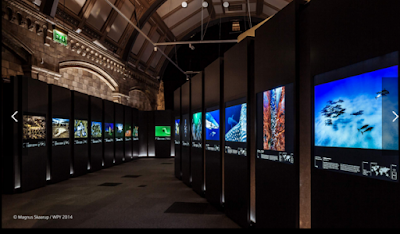
I really enjoyed this exhibition it was fascinating to see the work of others from ages of 7-15 there capability to produce such stunning images was inspirational. There were outstanding pieces of work on shop and what made the photographs look even more spectacular were the back lit panels they were displayed on. They made the colours and subjects jump out at the audiences which added more of a wow factor. This is something I have taken into consideration thinking about my own presentation of work which will go on display. This way is very effective and with my idea being along the lines of different lighting I feel this will illuminate my images and give it another dimension.



The Photographers Gallery
THE EASTER RISING 1916 SEAN SEXTON COLLECTION
Barricade made from barrels, 1916 © Sean Sexton Collection
Countess Markievicz, c. 1915 © Sean Sexton Collection
Sackville St ruins, 1916 © Sean Sexton Collection
This exhibition investigates the significant role played by photography in informing the national consciousness that led to Irish independence, using the 1916 rebellion as a central focal point. It features approximately eighty rarely seen photographs and ephemera, including souvenir postcards, albums, stereoscopic views, press and military photographs.
The exhibition encompasses a broad range of photographic documents of key events during the transformative years between the 1840s and 1930s. These include portraits of executed leaders, scrapbooks, collages and images of rebellion sites collected as memorabilia. Issues of authenticity and manipulation are explored in images of evictions and military drills - possibly staged for the camera. The contribution of women as active participants in the Rising is also addressed, as well as the women who practiced photography early in its development.
These photographic documents were utilised both by those fighting for and against autonomy from Westminster. For Nationalists, eviction images provided tangible evidence of British oppression, while pictures of Ireland’s pre-colonial archaeological monuments and contemporary rural life bolstered nationalist sentiments.
Conversely, British authorities and the Unionists in Northern Ireland circulated images of the Ulster Volunteer Force and loyal Irish recruits fighting on the front lines of WWI. These images were used to quash rumours of German support for Irish independence and to pave the way for the potential introduction of conscription.
Due to the complicated, costly and cumbersome nature of photography, when the rebellion finally broke out on 24 April 1916, the action itself was largely undocumented. Most of the surviving images were taken in the immediate aftermath and nearly all concentrate on the hostilities in and around the General Post Office on O’Connell St (then Sackville St). These stark scenes depict a bombed-out shell of Dublin, routinely referred to pre-rebellion as ‘the second capital of the Empire’.
Following six days of fierce clashes in which hundreds were killed and injured, the largely outnumbered rebel militias surrendered. Martial law was imposed across Ireland and leaders of the uprising were summarily executed. Before long their portraits, alongside photos of the site of execution in the prison yard at Kilmainham Jail, became widely available and informed a fresh groundswell of support for the Republican movement.
Subsequently, and in the brief lead up to the Civil War, photography played an extraordinarily powerful role in establishing archetypes such as the hunger striker, rebel, martyr, traitor and spy, while also elaborating on the Nationalists’ narratives which informed the new Irish Free State.
The exhibition encompasses a broad range of photographic documents of key events during the transformative years between the 1840s and 1930s. These include portraits of executed leaders, scrapbooks, collages and images of rebellion sites collected as memorabilia. Issues of authenticity and manipulation are explored in images of evictions and military drills - possibly staged for the camera. The contribution of women as active participants in the Rising is also addressed, as well as the women who practiced photography early in its development.
These photographic documents were utilised both by those fighting for and against autonomy from Westminster. For Nationalists, eviction images provided tangible evidence of British oppression, while pictures of Ireland’s pre-colonial archaeological monuments and contemporary rural life bolstered nationalist sentiments.
Conversely, British authorities and the Unionists in Northern Ireland circulated images of the Ulster Volunteer Force and loyal Irish recruits fighting on the front lines of WWI. These images were used to quash rumours of German support for Irish independence and to pave the way for the potential introduction of conscription.
Due to the complicated, costly and cumbersome nature of photography, when the rebellion finally broke out on 24 April 1916, the action itself was largely undocumented. Most of the surviving images were taken in the immediate aftermath and nearly all concentrate on the hostilities in and around the General Post Office on O’Connell St (then Sackville St). These stark scenes depict a bombed-out shell of Dublin, routinely referred to pre-rebellion as ‘the second capital of the Empire’.
Following six days of fierce clashes in which hundreds were killed and injured, the largely outnumbered rebel militias surrendered. Martial law was imposed across Ireland and leaders of the uprising were summarily executed. Before long their portraits, alongside photos of the site of execution in the prison yard at Kilmainham Jail, became widely available and informed a fresh groundswell of support for the Republican movement.
Subsequently, and in the brief lead up to the Civil War, photography played an extraordinarily powerful role in establishing archetypes such as the hunger striker, rebel, martyr, traitor and spy, while also elaborating on the Nationalists’ narratives which informed the new Irish Free State.
http://thephotographersgallery.org.uk/easter-rising-1916-2
This exhibition really interested me I took the time out to go around and read and examine each photograph. It interested me of how it documented something so powerful and strong, the way in which they were taken and how they have presented the images gave you an understanding and almost a sense of actually being there experiencing it for your self.
SAUL LEITER
It seems remarkable that Saul Leiter (1923-2013) is only just beginning to acquire significant mainstream recognition for his pioneering role in the emergence of colour photography.
He moved to New York intent on becoming a painter, which he continued in parallel with his photography, yet ended up working for magazines such as Harper's Bazaar, Elle and British Vogue and became known for his fashion work.
As early as 1946, and thus two decades before the 1970s new colour photography school (William Eggleston, Stephen Shore et al), Leiter was using Kodachrome colour slide film for his free artistic shots, despite it being despised by artists of the day. Instinctively for him, colour was the picture.
"I don't have a philosophy, I have a camera." Saul Leiter
An iconoclast who pursued his vision through signature framing devices, bold hues and relective surfaces, Leiter manages to transform seemingly ordinary street scenes in close proximity to his New York apartment into visual poetry.

Taxi, c 1957 © Saul Leiter Courtesy Howard Greenberg Gallery, New York

Snow, 1960 © Saul Leiter Courtesy Howard Greenberg Gallery, New York

Saul Leiter: Purple Umbrella, Paris, 1950s


Saul Leiters exhibition really inspired me his work with the colourful abstract like images really stood out for me. The injection of colour of inanimate objects or parts of the objects give the image a mystery about it.
My favourite image of which was on display is the Purple Umbrella:

The way in which he thought not to photograph the whole umbrella or include the person holding leaves part of the image to your imagination. Hes chose to have a shallow with the part of the umbrella the only thing in focus, by framing this way and using the settings he has gives the image a new dimension. Something so simple but so effective in the way it captures the viewers eye. The size his images were presented got me thinking about the sizes and structures I want to use for my own project to display. Big images framed with the mount window are much more effective than smaller images framed in an exhibition, I was drawn to the bigger sized images on display rather than the smaller ones although them images were still fine.
NATURAL HISTORY MUSEUM
Wildlife Photographer Of The Year 2015-2016 Exhibition
From intimate portraits to layered motion stills, the award-winners will blend startling visuals, compelling narratives, and a passion for the natural world.
The exhibition will feature more than 100 images exhibited on sleek back-lit photographic panels, creating a uniquely cinematic effect amid the splendour of the Waterhouse Gallery's Victorian architecture.
Look out for your chance to choose your own Wildlife Photographer of the Year winner with our People’s Choice vote, also launching 16 October. http://www.nhm.ac.uk/visit/wpy/visit/exhibition.html 29.03.2016


Wildlife Photographer of the Year 2015
Grand title winner
Don Gutoski, Canada
Don, an accident and emergency doctor, enjoys de-stressing on his 40-hectare piece of land in Canada, which he keeps completely wild. Nature has always been one of his passions, and his fascination with photography started in his teens. He enjoys travelling the world, seeing incredible wildlife, and the challenge of recording these moments. Canon EOS-1D X + 200-400mm f4 lens + 1.4x extender at 784mm; 1/1000 sec at f8; ISO 640.

WINNER
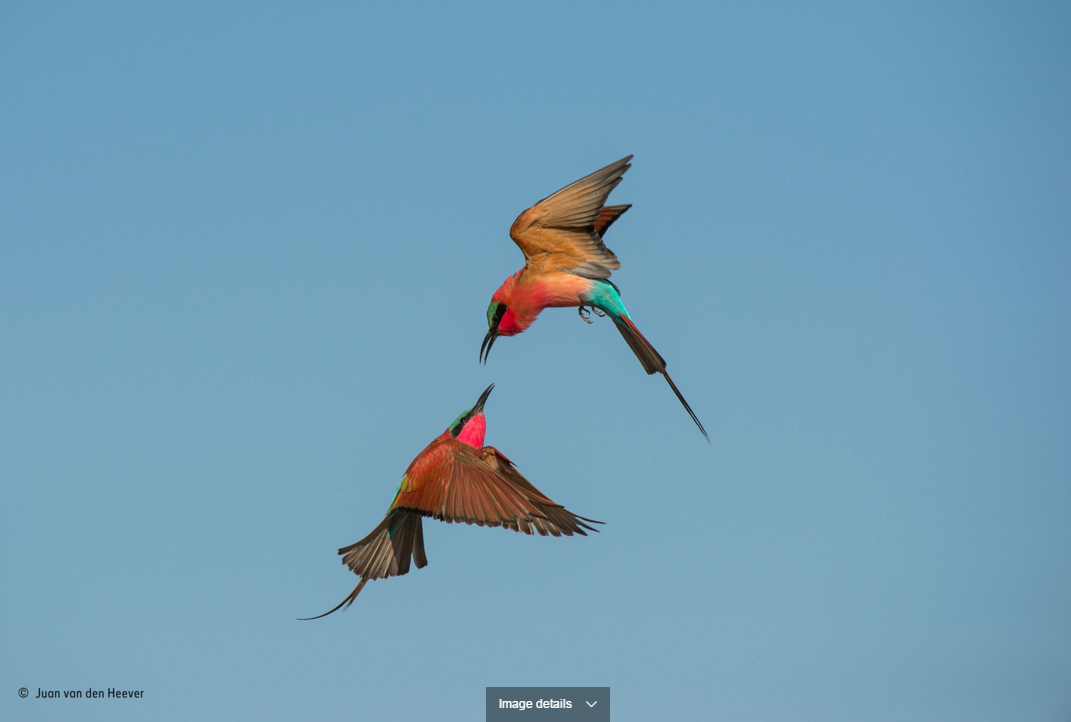
10 Years and Under


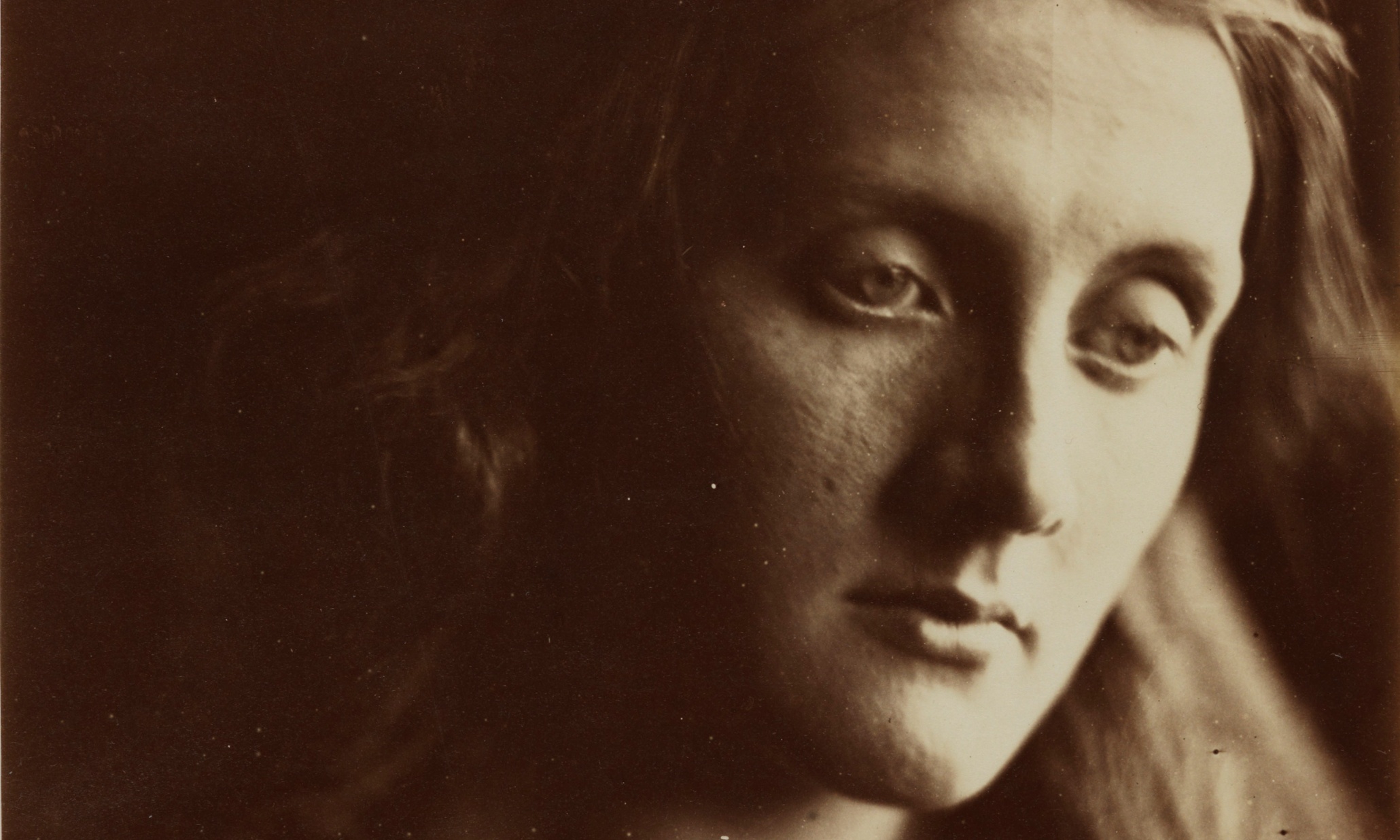
Julia Margaret Cameron 11 June 1815 Calcutta – 26 January 1879 Kalutara, Ceylon) was a British photographer. She became known for her portraits of celebrities of the time, and for photographs with Arthurian and other legendary or heroic themes.
Cameron's photographic career was short, spanning eleven years of her life (1864–1875). She took up photography at the relatively late age of 48, when she was given a camera as a present. Her style was not widely appreciated in her own day: her choice to use a soft focus and to treat photography as an art as well as a science, by manipulating the wet collodion process, caused her works to be viewed as "slovenly", "mistakes" and bad photography. She found more acceptance among pre-Raphaelite artists than among photographers. Her work has had an impact on modern photographers, especially her closely cropped portraits. Her house, Dimbola Lodge, on the Isle of Wight is open to the public.

Subscribe to:
Comments (Atom)